
 English
  繁体中文
繁体中文  Spanish
  Hungarian
  Serbian
  Slovak
  Slovenian
  Romanian
  Dutch
Dutch  Russian
  Bulgarian
  Кыргызча
  O'zbekcha
 Selecting the right tank for an HVAC project is not simply a matter of choosing a suitable capacity. The tank must match the heat pump configuration, water demand, temperature range, installation space, circulation requirements, and expected operating conditions. Two common options are a thermal storage tank and a buffer tank, but they serve different purposes even though their functions can overlap.
For engineers, distributors, and HVAC equipment manufacturers, understanding this distinction can prevent oversizing, unnecessary energy consumption, unstable operation, and difficult installation. A thermal storage tank can provide meaningful heat storage and domestic hot water support, while a buffer tank is generally selected to improve water volume, reduce short cycling, and stabilize heating or cooling operation. The right choice depends on what the project actually needs the tank to accomplish.
What Does Thermal Storage Tank Do?
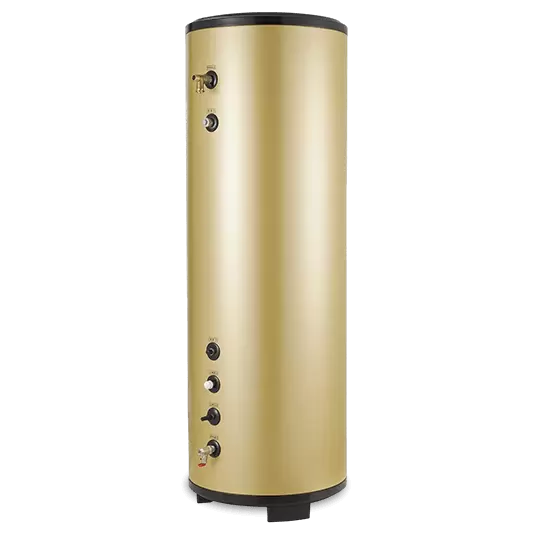
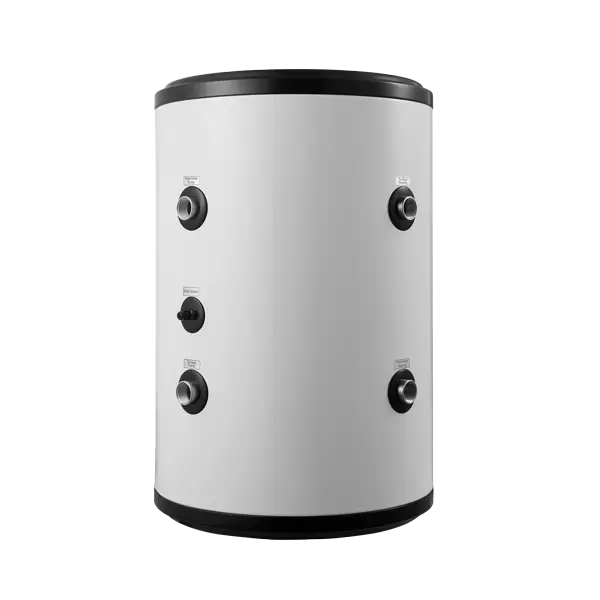
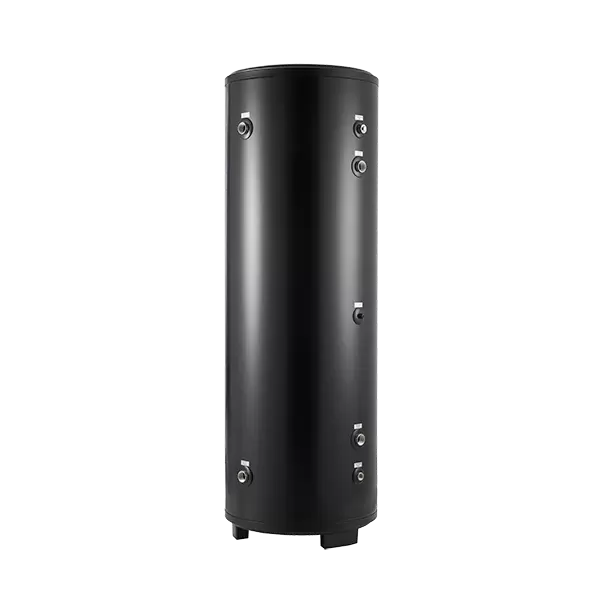
A thermal storage tank stores heated or cooled water so that thermal energy can remain available when the heat source is not operating at full output. Instead of requiring the heat pump to respond immediately to every change in demand, stored energy can help bridge the difference between generation and consumption. This makes the tank particularly useful in applications where heating loads fluctuate throughout the day.
Depending on the configuration, a thermal storage solution can support heat pump heating, domestic hot water, central heating, HVAC load balancing, and selected heat recovery applications. It can also incorporate heating coils or other connections according to project requirements. For commercial and industrial installations, this flexibility allows the tank to become part of a broader heat management strategy rather than functioning only as a passive water container.
The actual design should consider tank volume, operating temperature, heat source capacity, water circulation, insulation, connection arrangement, and available installation space. These factors influence how effectively stored energy can be used and how consistently the HVAC equipment operates.
How Buffer Tank Supports HVAC Operation
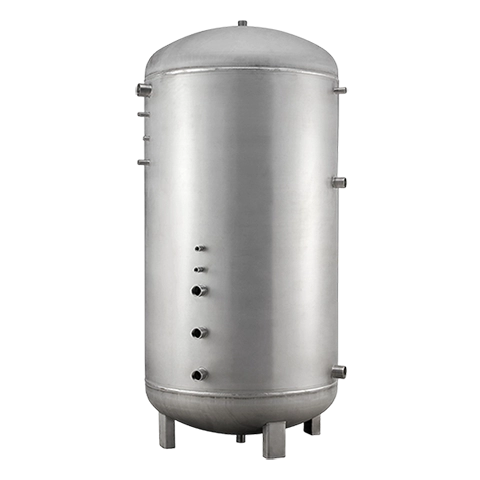
A buffer tank primarily adds water volume to a heating or cooling circuit. This additional volume can help stabilize water temperature and reduce frequent starts and stops of heat pump equipment. Short cycling can occur when the heat load changes rapidly or when the connected water volume is too small for the capacity of the heat source.
For HVAC applications, a buffer tank can therefore improve operational stability without necessarily being designed for substantial long-duration thermal storage. It is often considered when the main concern is minimum water volume, temperature stability, flow management, or heat pump cycling.
Although the two tank types can perform overlapping functions, their design priorities are different. A project that needs domestic hot water storage or meaningful thermal energy retention may require a more comprehensive storage arrangement. A project mainly experiencing unstable heat pump operation may benefit from a simpler buffer configuration.
Thermal Storage Tank vs Buffer Tank: Key Differences
The distinction becomes clearer when the two options are compared according to their primary engineering purpose.
| Consideration | Thermal Storage Tank | Buffer Tank |
|---|---|---|
| Primary purpose | Store thermal energy | Stabilize water volume and flow |
| Heat pump cycling | Can help reduce cycling | Commonly used for this purpose |
| Energy storage | Strong emphasis | Usually secondary |
| HVAC buffering | Suitable | Highly suitable |
| Domestic hot water | Can be configured for DHW | Usually not the primary function |
| Heating coil options | Available depending on design | Depends on configuration |
| Application flexibility | High | Focused on circuit stabilization |
| Customization | Capacity, ports, coils and materials | Primarily capacity and connections |
This comparison does not mean one tank is universally better. The correct choice is determined by the thermal load profile and the intended function of the water circuit. In some projects, a properly designed tank can combine buffering and thermal storage functions, reducing the need for separate components.
When Heat Pumps Need More Than Simple Buffering
Heat pumps are highly sensitive to changes in load, flow, and water temperature. When the connected circuit has insufficient water volume, the heat pump may reach its target temperature too quickly and shut down before operating for an efficient period. Repeated starts can make temperature control less stable and place additional demands on equipment components.
A thermal storage tank for heat pump systems provides additional water volume while also retaining usable thermal energy. When demand temporarily exceeds heat generation, the stored heat can contribute to the load. When demand falls, the tank can absorb available thermal energy rather than forcing the heat pump to respond immediately to every small variation.
This becomes particularly relevant for buildings with variable occupancy, intermittent hot water demand, or heating loads that change significantly between different operating periods. The tank should be sized according to the actual load characteristics rather than simply selecting a larger capacity for additional storage.
Choosing the Right Tank Capacity
Capacity selection is one of the most important decisions in an HVAC tank project. An oversized tank may require more installation space, increase heat loss, and add unnecessary material cost. An undersized tank may not provide enough stored energy or water volume to achieve the intended operating improvement.
Engineers should evaluate several factors before determining the required volume. These include the heat pump output, minimum operating time, required temperature differential, peak demand, expected load variation, domestic hot water requirements, and available installation space. The required tank volume should be calculated from the project rather than selected solely according to the nominal output of the heat pump.
For commercial applications, demand patterns should also be considered. Hotels, residential buildings, and facilities with sanitary hot water requirements can experience significant differences between average and peak demand. A correctly selected tank can provide additional thermal capacity without requiring the heat source to match every short-term demand fluctuation.
Material Selection for Thermal Storage Applications
Material selection becomes increasingly important when a tank is exposed to hot water, demanding water quality, or corrosive operating conditions. SS304, SS316L, and Duplex 2205 stainless steel provide different levels of corrosion resistance and mechanical performance, allowing the tank construction to be matched to the intended application.
SS304 is widely suitable for general hot water and heating applications, while SS316L may be preferred where greater corrosion resistance is required. Duplex 2205 can provide higher mechanical strength and corrosion resistance for more demanding environments. The final selection should be based on water chemistry, temperature, pressure, project specifications, and expected service conditions.
The external shell can also be customized according to installation and appearance requirements. Galvanized steel with a painted finish or stainless steel can be selected, while different exterior colors are available for projects requiring a particular visual finish.
Insulation Matters More Than Tank Size Alone
Increasing storage volume does not automatically guarantee better thermal performance. Heat stored inside the vessel can gradually escape through the tank wall and external connections, especially when the surrounding environment is significantly cooler than the stored water.
For this reason, polyurethane insulation is an important part of thermal storage tank construction. Proper insulation reduces standing heat loss and helps retain useful thermal energy between heating cycles. The insulation thickness should be considered together with operating temperature, ambient conditions, tank geometry, and installation location.
Connection points, valves, fittings, and exposed piping should also be considered during installation because these areas can become additional heat-loss paths. A well-insulated tank therefore needs to be evaluated as part of the complete installation rather than as an isolated vessel.
Heating Coils and Multi-Function Configurations
Not every HVAC project uses the same heat-transfer arrangement. Depending on the application, a tank may require flat coils, wave coils, or refrigerant system coils. The appropriate coil configuration depends on the heat source, heat-transfer medium, required heat-transfer performance, and available installation space.
A multi-function configuration can also combine thermal storage with domestic hot water, heat recovery, or system buffering functions. This flexibility is valuable for projects where several thermal requirements need to be handled within a compact footprint.
For OEM and ODM projects, connection positions and coil arrangements can be customized according to the equipment layout. This is especially useful for HVAC manufacturers and engineering contractors that need the tank to integrate with their own equipment rather than adapting the entire installation around a fixed tank design.
Installation Space and Connection Design
Tank selection should not be separated from installation planning. Vertical, horizontal, and wall-mounted configurations can provide different advantages depending on available floor space, ceiling height, service access, and piping arrangement.
In confined mechanical rooms, the physical dimensions of the tank and the location of water connections can be just as important as its nominal capacity. Custom ports and connection specifications can simplify integration with existing piping and reduce unnecessary bends or additional fittings.
Service access should also be considered. Engineers need sufficient clearance for inspection, connection maintenance, electrical components, anode replacement where applicable, and pressure testing. A compact tank that cannot be properly serviced may create greater long-term problems than a slightly larger tank with better accessibility.
Pressure and Temperature Considerations
Operating pressure and temperature should always be evaluated against the requirements of the complete HVAC installation. The tanks offered by Legend are designed with a maximum working pressure of 6 bar, testing pressure of 10 bar, and maximum running temperature of 90°C for the listed standard range.
These figures should not be treated as a substitute for project-specific engineering. Actual operating conditions depend on the heating source, circulation arrangement, safety devices, water quality, and applicable installation requirements. Pressure relief components and other protective measures should be selected according to the complete installation.
Strict pressure and leakage testing during manufacturing is equally important. Legend Tank applies sequential quality control throughout fabrication, including welding, pressure testing, and leakage inspection, helping maintain structural tightness and consistent product quality.
Why OEM and ODM Customization Can Improve Project Fit
Standard tanks are convenient when the application matches an existing configuration. However, engineering projects often have different requirements for capacity, ports, coils, material, insulation, external finish, or installation orientation. This is where OEM and ODM thermal storage tank manufacturing can provide greater flexibility.
Legend supports customization of tank volume, connection ports, heating coil configurations, exterior finishes, and customer logos. The product range covers capacities from 60L to 2000L, while customized solutions can be developed around specific project requirements.
For overseas distributors and HVAC equipment manufacturers, OEM/ODM production can also simplify product branding and integration. Instead of modifying an existing installation to accommodate a standard tank, the tank can be configured around the intended equipment arrangement.
Manufacturing Quality of Custom Tank
Customization is only useful when manufacturing consistency is maintained. Tank fabrication involves multiple stages, including stainless steel plate cutting, cylinder rolling, nozzle welding, pressure testing, insulation, and final inspection. Each stage can influence the tank's durability and leakage resistance.
Legend Tank has 17 years of professional welding experience, with certified welders involved in production. The manufacturing process includes online leakage testing and pressure holding procedures, while key components can be sourced from established industry suppliers according to the required configuration.
For international projects, quality documentation and certification are also important purchasing considerations. Legend's tanks are supplied with CE and ISO9001 certification, supporting the requirements of overseas distributors, contractors, and equipment manufacturers.
Which Option Should HVAC Buyers Choose?
A buffer tank is generally appropriate when the primary objective is to increase circuit volume, stabilize water temperature, or reduce heat pump cycling. A thermal storage tank becomes more attractive when the project needs meaningful energy storage, domestic hot water support, heat recovery, or a combination of thermal functions.
There is also no requirement to treat the two categories as completely separate products. A properly configured multifunction thermal storage tank can provide both buffering and energy storage, depending on its internal arrangement and connection design. This can be particularly useful when an HVAC project has multiple thermal demands but limited installation space.
The most practical selection process begins with the application rather than the tank name. Determine the required function, calculate the appropriate capacity, evaluate water temperature and pressure, select a suitable stainless steel grade, and then consider connection layout and installation space. This approach produces a tank specification that is easier to integrate and more closely aligned with actual operating conditions.
FAQ
Is a thermal storage tank the same as a buffer tank?
No. They can perform overlapping functions, but their primary purposes differ. A buffer tank mainly increases water volume and stabilizes HVAC operation, while a thermal storage tank places greater emphasis on retaining usable thermal energy. Some multifunction designs can provide both functions.
Can a thermal storage tank work with a heat pump?
Yes. Thermal storage tanks are widely applicable to heat pump heating and HVAC applications. They can provide additional water volume, help manage load fluctuations, and retain thermal energy for later use. Correct sizing and connection design are essential for effective operation.
What stainless steel is suitable for a thermal storage tank?
SS304, SS316L, and Duplex 2205 can all be used depending on the application. The appropriate grade should be selected according to water chemistry, corrosion exposure, temperature, pressure, and project requirements.
Can the tank be customized for OEM projects?
Yes. Legend supports OEM and ODM customization, including capacity, connection ports, heating coil configuration, exterior shell, color, and customer logo. This allows the tank to be adapted to different HVAC, heat pump, DHW, sauna, and industrial applications.
How should a thermal storage tank be sized?
Tank sizing should consider heat pump capacity, load profile, required temperature difference, operating time, peak demand, domestic hot water requirements, and available installation space. A larger tank is not automatically better because excessive capacity can increase cost, space requirements, and standing heat loss.
Is insulation important for stored hot water?
Yes. Effective insulation reduces heat loss from stored water and helps maintain useful thermal energy between heating cycles. Polyurethane insulation is commonly used for this purpose, while the complete installation should also address heat loss through connections and exposed piping.
Final Considerations
The decision between a buffer tank and a thermal storage tank should be based on the actual thermal requirements of the HVAC project rather than on terminology alone. Buffering is primarily concerned with water volume, flow stability, and equipment cycling, while thermal storage adds the ability to retain and manage usable thermal energy over time.
For projects involving heat pumps, HVAC, domestic hot water, central heating, sauna heat recovery, or industrial refrigeration, a customized tank can provide greater flexibility than a fixed standard configuration. With SS304, SS316L, and Duplex 2205 construction, multiple installation orientations, customizable connections and coils, polyurethane insulation, and OEM/ODM manufacturing support, Legend Tank can develop tank solutions around different engineering requirements.